Story #1 THE SOCK SNATCHER
Civilization began around a fire, and so did our nightmares.
When we sit around a campfire, the sun has gone down, the walls of our homes are miles away, and the circle of light from the flames is the only "safe" place left. This is where the storyteller becomes a magician. A good yarn isn't just a sequence of events; it is an experience that uses the environment to blur the line between fiction and reality.
To tell a story well, you must understand your goal. Are you looking to spark a nervous laugh? Do you want to leave them checking under their sleeping bags? Or do you want to teach a lesson that sticks in their ribs like a cold wind?
In this guide, we will look at three distinct types of stories and, more importantly, the mechanics of how to deliver them so they are never forgotten.
Story 1.
The Sock Snatcher
Living in a basement bedroom is mostly cool. It’s private, it’s quiet, and it stays a chilly 60 degrees year-round. But Tina didn’t move down here for the "vibe." She had been banished to the subterranean depths because her upstairs room looked like a fabric-based natural disaster. Her parents decided the basement was the only place her "Laundry Cyclone" couldn't hurt anyone else’s eyes. Maybe being close to the laundry room would help Tina be less messy.
The laundry room was creepy and it sat tucked behind her closet like a dark, damp secret. It smelled like a confusing mix of lavender detergent, ancient dryer lint, and something... organic. Lately, it had started making noises at night.
Every night around 11:00 PM, the sound would start.
Scritch. Scritch. Scritch-slurp-scritch.
"It’s just a squirrel in the dryer vent, Tina," her dad said, eyes glued to his phone. "They like the warmth. If you’d pick up your clothes and hang them in your closet, you wouldn't hear it so clearly."
"But I’m losing things!" Tina argued, pointing to her bare feet. "My socks are disappearing. It’s like the floor is eating them."
"I'll look into it" her dad replied
Her mom’s voice drifted down the stairs like a haunting refrain: "You’d be able to find your things, Tina, if you weren't so messy! Check under the mountain of hoodies."
But when Dad pulled the vent tube off the wall...nothing??!!??
No nests, no nuts, no squirrels. Just a hollow metal tube and the heavy, humid feeling of being watched by something without a face.
Then things got targeted. Tina wasn't just losing socks to the "mess"—she was losing the elite ones. The fuzzy neon green ones with the grips on the bottom. Her lucky "Taco Tuesday" socks. A single, vintage striped tube sock she’d had since middle school.
"Check the hamper!" her mom shouted. But the hamper was a hollow plastic lie. Tina’s drawer was becoming a graveyard of lonely, single socks, all mourning their missing partners.
The breaking point came on a Tuesday before bed. Tina stepped out of the shower, wrapped in a towel, when a heavy THUD echoed from behind the dryer.
She peeked around the corner and saw a flash of movement. Something small, fleshy, and impossibly fast scurried into the four-inch gap between the washer and the wall. In its wake, it left a trail of damp lint and a tiny, retreating glimpse of a checkered Van sock.
That night Tina didn't sleep. She grabbed a heavy flashlight, a bag of Cheetos for courage, and sat on the edge of her bed, staring at the laundry room door.
11pm.... silence, just the ticking of her watch.
12 am.... someone flushed a toilet upstairs.
1am... The hum of the water heater.
2am....The settling of the house.
3:14 AM... Scritch. Scritch. Gurgle.
A shadow detached itself from the baseboard. Tina held her breath, clicked the flashlight to high-beam, and blasted the floor with light.
It wasn't a squirrel. It wasn't a ghost. It was a physical manifestation of a messy room nightmare.
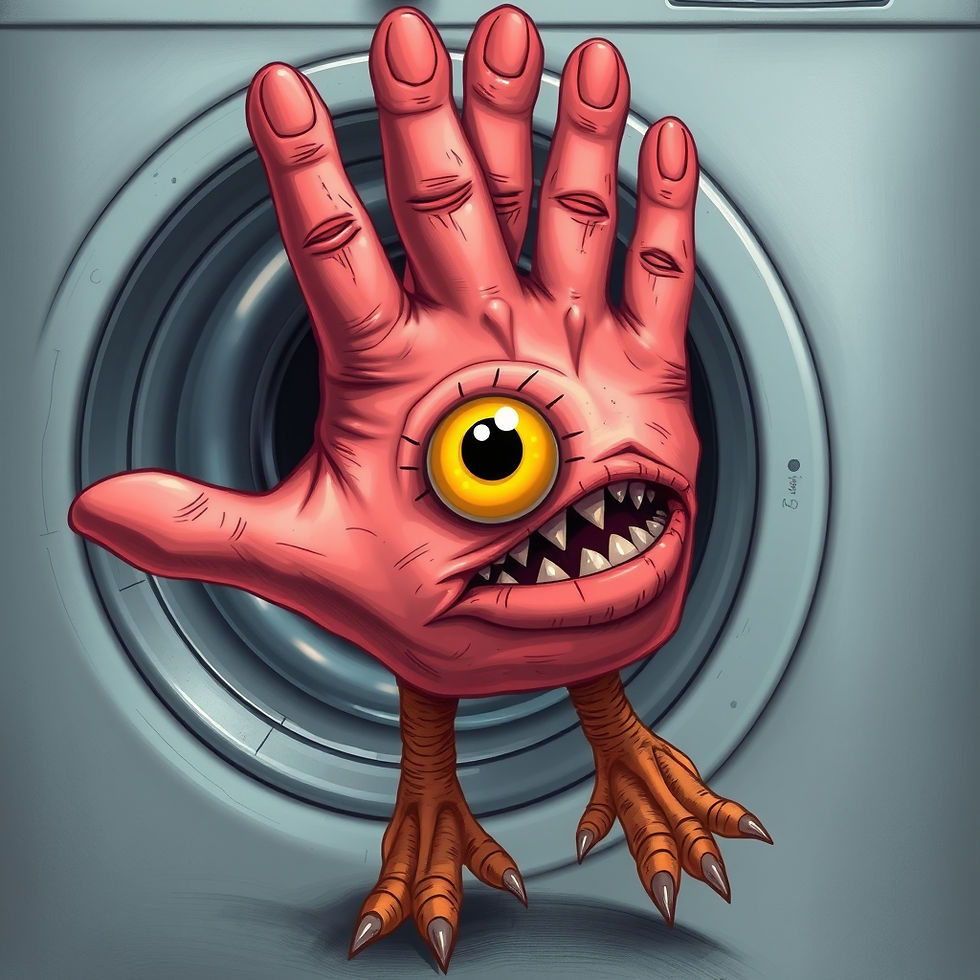
It was a hand. A pale, muscular, severed hand—but it wasn't "dead." It ended in a clean, rounded wrist, and instead of crawling on its fingers, it stood on two tiny, bird-feet that sprouted from the base of the palm.
As Tina watched in frozen horror, the hand rotated.
In the center of the palm sat a single, bulging yellow eyeball. Below the eye, a jagged horizontal slit tore open—a mouth filled with needle-like teeth. From that mouth hung Tina’s favorite wool hiking sock, half-swallowed and dripping with a thick, soapy slime.
The "Hand" blinked its palm-eye at her. It gave a muffled, wet growl through the wool, then used its index finger to "wave" a mocking goodbye before sprinting into the shadows with the squeaky sound of wet sneakers on a gym floor.
Tina didn't scream. She didn't run. She just looked at the piles of clothes on her floor—the perfect hiding spots, the endless buffet of cotton, polyester and wool she had provided for the monster.
She realized then that her mom was right, she could have found her things if she weren't so messy. But now, she didn't want to find them. She didn't want to know what else was living in the "Laundry Cyclone."
Tina spent the rest of the night on top of her dresser.
The next morning, she didn't just clean her room—she bleached it until it sparkled. As she looked at her bare feet, she knew she could never trust a sock drawer again.
Because once the Hand gets a taste for wool, it’s only a matter of time before it starts looking for toes.
From now on, she was only wearing sandals.
The end.
The Sock Snatcher is a Modern Urban Legend. It works because it takes a universal human experience—losing a sock in the wash—and provides a visceral, terrifying explanation for it. This story is best told to an audience that might have messy rooms or "laundry cyclones" of their own.
The Sensory Build-up: The basement is the perfect setting for a campfire tale because it’s naturally damp and dark. Spend time describing the smells. Mention the "lavender detergent" mixed with "organic rot." Smells are powerful triggers for memory; your audience will start to "smell" the laundry room as you speak.
Foley Sound Effects: This story relies on specific, weird noises.
The Scritch-Slurp: Use your fingernails to scratch the side of a log or a chair, then make a wet sucking sound with your mouth. The Squeaky Sneaker: When the hand runs away at the end, rub two fingers together or rub a balloon-like surface to mimic that "squeak-squeak" sound of wet rubber on a floor. It adds a touch of "funny-scary" that makes the monster feel more physical.
The Slow Reveal-- If you are using a flashlight for your storytelling, keep it pointed at the ground or under your chin. When you reach the part where Tina "blasts the floor with light," flick your flashlight to its brightest setting and point it at an empty spot in the middle of the circle. This mimics Tina’s flashlight and makes the audience feel like they are looking right at the palm-eye.
The "Toes" Warning: The final line of this story is a Threat of Proximity.
After you finish the story, look down at the feet of the people sitting closest to you.
If anyone is wearing socks, give a small, knowing wince.
If anyone is wearing sandals, nod approvingly and say, "Wise choice."
The "Clean Your Room" Moral
This is a "Boogeyman" story used for behavioral correction. By the end, the kids shouldn't just be afraid of the Hand; they should be afraid of the piles of clothes on their floor. You are turning their own mess into a hiding spot for a predator.


Comments